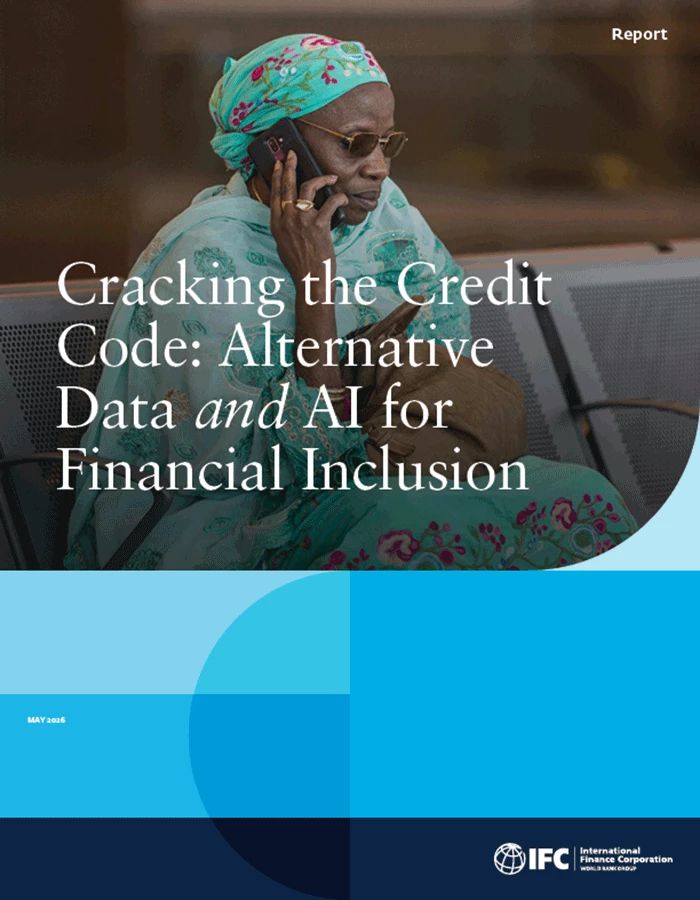
Kifiya has been featured by the World Bank Group and IFC in their newly released global insights report, Cracking the Credit Code: Alternative Data and AI for Financial Inclusion, recognized as a model of AI driven infrastructure redefining how capital reaches the economies that need it most.
The report examines how technology enabled financial ecosystems are addressing one of emerging markets’ most persistent structural failures: economically active MSMEs and smallholder farmers remain invisible to financial systems not because they lack economic activity, but because the infrastructure to measure, trust, and serve them at scale has never existed.
Kifiya’s inclusion highlights its decade long work building that infrastructure from the ground up. Since 2012, the company has developed four integrated infrastructure layers spanning AI driven risk decisioning, intelligent financial rails, capital structuring systems, and skills and market linkage platforms that collectively enable banks, microfinance institutions, and digital platforms to extend responsible, uncollateralized credit to borrowers with no collateral and no formal credit history.
The results are measurable. To date, Kifiya’s infrastructure has unlocked USD 755 million in credit and insurance, scored over 4 million loan applications, and served more than 800,000 MSMEs and 1.1 million smallholder farmers across Ethiopia.
Through SAFEE, the Sustainable Access to Finance to Enable Entrepreneurship program co created with the Mastercard Foundation, more than 502,000 women led enterprises have accessed formal financing, many for the first time, with 99 percent women borrowers and 76 percent youth.
The World Bank Group and IFC recognition comes as Kifiya expands its infrastructure platform across 14 African countries, with offices in, Nairobi, Cape Town, and soon Kigali.
The company has also been recognized with the Global SME Finance Award for Product Innovation of the Year in 2024 and the Global EFICA Award for Innovative Ethical Finance in 2025.
At the core of Kifiya’s model is a single insight: the problem was never a lack of capital or a lack of economic activity. It was the absence of infrastructure connecting the two. The World Bank Group and IFC recognition reinforces that the infrastructure Kifiya has built in Ethiopia represents a replicable architecture for inclusive economic growth across the continent.
For Africa’s broader technology ecosystem, Kifiya’s recognition carries particular significance. It demonstrates that infrastructure solving some of Africa’s most complex development challenges can be built in Africa, by Africans, for African markets.