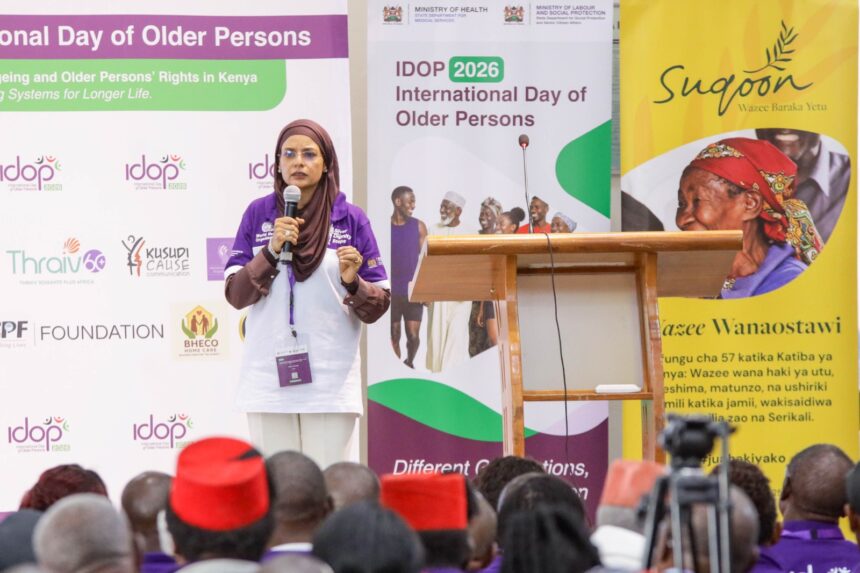
Kenya’s progress in extending life expectancy must now be matched by social protection systems that enable people to age with health, independence and dignity, rather than waiting until vulnerability becomes a crisis, Suqoon Founder Shakira Khawaja has said.
Khawaja made the case for a more preventive and person-centred approach to ageing during discussions on social protection for older persons at the Fourth Kenya Social Protection Conference in Nairobi.
She said Kenya’s ageing policies should focus not only on providing financial assistance when older people become vulnerable, but also on protecting their health, preserving independence and enabling them to remain active contributors to their families and communities.
“We worked hard for people to live longer. Now let us make sure our systems are ready for those longer lives, and that those lives are lived with function, contribution and dignity,” Khawaja said.
Her remarks came as the Government seeks to strengthen Kenya’s social protection framework and expand the number of households covered by social assistance programmes.
During the conference, President William Ruto, in a speech read on his behalf by Labour and Social Protection Cabinet Secretary Alfred Mutua, committed the Government to establishing and capitalising a Social Protection Fund, making benefit indexation predictable and expanding coverage to 2.5 million households.
The President also directed that a national school meals programme be introduced in all 47 counties in the first term of 2027.
The focus on social protection comes against a backdrop of a rapidly growing older population.
The number of Kenyans aged 60 and above is projected to increase from about 2.9 million currently to 6.4 million by 2045, according to specialists briefing the media ahead of Kenya’s inaugural International Day of Older Persons national celebration.
For Khawaja, the demographic shift requires policymakers to consider ageing as a health, economic and social issue rather than treating it solely as a welfare concern.
She argued that health and social protection are closely connected in the daily lives of older people.
A fall in the home, for example, can result in a fracture, hospitalisation, loss of mobility and increased dependence. The consequences can extend beyond the older person, with a son or daughter sometimes having to leave employment or reduce working hours to provide care.
Suqoon, working with partners including Safaricom and the Chandaria Foundation, modifies older people’s homes to reduce the risk of falls and improve safety.
“That grab rail is not just a renovation. It is health protection. It is caregiver protection. It is social protection,” Khawaja said.
She urged delegates to carry three commitments into the conference’s Call to Action, which was due to be signed on 1 October.
The first is a clear pathway to address the protection gap between the age of 60, when Kenya’s Constitution recognises a person as an older person, and 70, when the Older Persons Cash Transfer begins.
The second is stronger protection of older people’s income, property and assets against abuse. Khawaja also called for progress on the Older Persons Bill, 2024, which had not been tabled in Parliament despite the completion of public participation in 2024.
The third is an assisted route for older people who cannot independently use digital payment platforms and other digital services.
The growing reliance on digital systems, she argued, should not leave older people behind, particularly those who lack the skills, access or physical ability to use digital services without assistance.
Khawaja also called for a shift in how Kenya views older people and their contribution to society.
Many older people continue to raise grandchildren, farm, operate businesses, participate in savings groups and provide support to extended families. Their contribution, she said, is often overlooked when ageing is discussed primarily in terms of dependency.
“An elder is not where the life cycle closes. She is where it turns. When we invest in an older person, the return does not stop with her. It moves through the family, the community and into the next generation,” she said.
The importance of social connection was also highlighted by older people participating in Suqoon’s community activities in Nairobi’s Mathare and Embakasi areas.
For 64-year-old Ann Wanjiru Mbuthia, Organising Secretary at Mathare Older Persons Network, stronger interaction between generations is necessary to improve understanding of the needs and experiences of older people.
“We need more conversations between generations. Young people need to understand what older people go through and why they need to be cared for. There is a lot that younger people can learn from older people,” Mbuthia said.
Peter Oyugi, 65, from Embakasi, said community spaces can help address isolation among older people.
“Suqoon has given us a space where we can come together, talk and interact. Sometimes an older person can stay in the house for many days without going anywhere. Having this space gives us a reason to come out and feel part of the community,” Oyugi said.
The discussions place increasing attention on the need for Kenya’s social protection system to anticipate the consequences of demographic change.
As the population of older people grows, the pressure will extend beyond cash transfers to healthcare, housing, mobility, income security, caregiving, digital access and community support.
For Khawaja, preparing for that future means moving from responding to vulnerability after it occurs to preventing avoidable loss of independence in the first place.
The Fourth Kenya Social Protection Conference was held from 29 September to 1 October under the theme, “Re-imagining Social Protection in an evolving socio-economic landscape and climate change: Strengthening Adaptive, Transformative and Sustainable Social Protection Systems for Inclusive Development in Kenya.”