Africa’s shortage of cybersecurity professionals is emerging as a major challenge to protecting its fast-growing digital economy, with approximately 200,000 positions awaiting qualified workers, according to a new Mastercard-commissioned whitepaper.
The report, Africa’s Digital Defense Race, estimates that the vacancies represent a shortfall equivalent to 23% of the continent’s current cybersecurity workforce.
The warning comes amid a sharp increase in cyber threats targeting African organisations. According to Mastercard Cyber Insights, more than 69,000 cyber events were observed against African organisations in 2025, averaging approximately one every eight minutes.
Cyberattacks across the continent increased by more than 421% between 2016 and 2025, exceeding the global growth rate of 307%, the report found.
The rise in threats coincides with the rapid expansion of digital financial services and online commerce. Mobile money users grew 5.9-fold over the decade to 2025, digital banking users increased 4.7-fold, and the e-commerce market expanded 5.3-fold.
Africa’s digital payments economy is projected to reach USD 1.5 trillion by 2030.
Related report: Mastercard projects Africa’s digital payments economy will reach USD 1.5 trillion by 2030.
Strengthening skills and preparedness
Shabir Ahmed, Senior Vice President and Customer Solutions Center Lead for Africa at Mastercard, said protecting the continent’s digital expansion requires a coordinated response from both the public and private sectors.
“As threats become more sophisticated and coordinated, our response has to be just as coordinated,” Ahmed said, pointing to the Africa Cybersecurity Center of Excellence as a platform for sharing intelligence, knowledge and best practices.
The initiative also supports organisations in strengthening their readiness through scenario-based exercises and engagement among security teams.
Further information: Mastercard launches Africa Cybersecurity Center of Excellence.
The report argues that investment in skills must accompany improvements in cybersecurity infrastructure, governance and cooperation if African countries are to manage the risks associated with digital expansion.
Financial and public services among key targets
Technology, public sector organisations and financial services accounted for 44% of observed cyber activity, reflecting the importance of these sectors to the continent’s digital development.
Personal information, financial information and customer-facing services together accounted for 27% of targeted assets, exposing the potential consequences of attacks for citizens and businesses.
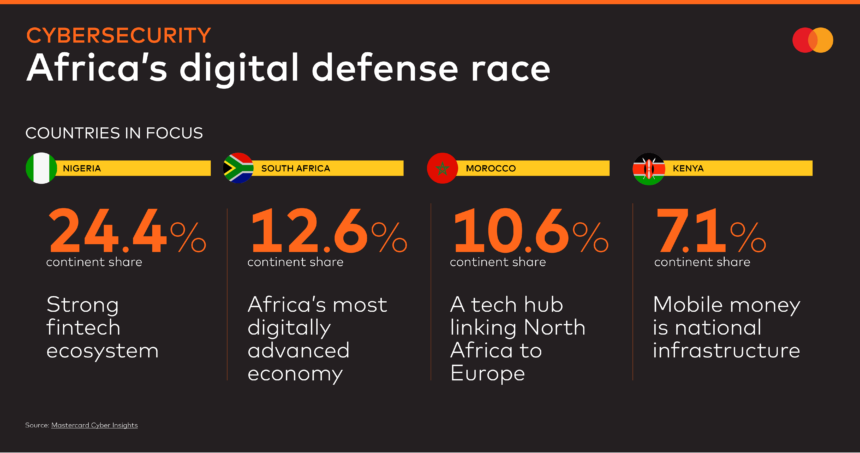
The threat varies across markets. Nigeria’s large fintech ecosystem accounted for a significant share of observed attacks in 2025, while South Africa’s financial sector was targeted by 12.6% of the attacks recorded across Africa.
Morocco has developed a comparatively institutionalised cybersecurity governance framework. Kenya’s priorities include protecting the systems that support digital payments, financial inclusion and wider economic growth.
Cross-border cooperation gains ground
Joint enforcement operations show the importance of regional collaboration in responding to cybercrime. Interpol’s Operation Serengeti 2.0, conducted from June to August 2025, resulted in 1,209 arrests across 18 African countries and the recovery of USD 97.4 million.
Operation details: Interpol’s Africa-wide cybercrime and fraud crackdown.
Mastercard says the Africa Cybersecurity Center of Excellence brings together governments, financial institutions and businesses to improve intelligence sharing, monitor emerging risks and strengthen collective defence.
The full Africa’s Digital Defense Race whitepaper outlines the cybersecurity priorities facing the continent and is available online.
Access the report: Africa Cybersecurity Whitepaper.