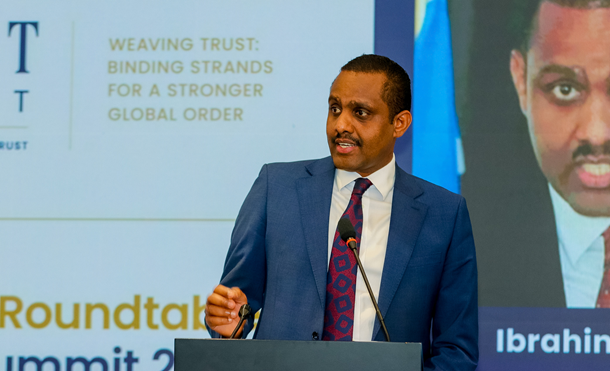
Kenya’s private sector is pushing for stronger trust between government, businesses and citizens, saying confidence in institutions is essential for unlocking investment, strengthening regional trade and building a more resilient economy.
Business leaders made the call during a high-level Private Sector Roundtable in Nairobi held ahead of the country’s first Trust Summit, which will take place from October 21–23, 2026.
The roundtable, held under the theme “Trust as an Economic Asset: Strengthening Public-Private Dialogue, Regional Economic Cooperation and Digital Trust for Market Resilience and Sustainable Growth,” brought together private sector representatives and other stakeholders to explore the economic value of trust and its role in improving market confidence and competitiveness.
The meeting comes as businesses globally contend with economic uncertainty, geopolitical tensions and rapid technological change that are reshaping investment decisions, trade and interactions between governments and the private sector.
Delivering a keynote address on behalf of Dr. A. Korir Sing’Oei, Principal Secretary, State Department for Foreign Affairs, Mr. Mustafa Ibrahim, Deputy Director-General and Head of the Policy, Research and Strategic Analysis Directorate, said trust had become an important determinant of economic performance.
“We meet at a time of considerable headwinds in the global economy. Confidence in institutions has come under strain, economic uncertainty has risen, geopolitical tensions persist, and rapid technological change is reshaping how governments, businesses and citizens interact,” Ibrahim said.
He said government had to provide a stable and predictable policy environment, while the private sector had an equally important responsibility to promote ethical leadership and responsible corporate governance.
According to Ibrahim, these measures would help create an environment capable of attracting investment, expanding markets and supporting innovation.
Prof. XN Iraki of the University of Nairobi said low levels of trust impose direct costs on businesses by increasing the resources required to secure transactions and protect investments.
“When people trust each other, businesses spend less on contracts, audits, and security, and can charge more without losing customers. Investors show up too. But when trust breaks down, everyone pays for it: higher interest rates, more red tape, slower growth,” he said.
Mathias Kamp, Country Director of the Konrad-Adenauer-Stiftung Kenya Office and co-convener of the Trust Summit, said investment in infrastructure alone could not guarantee economic development without trusted institutions.
“Trust is a prerequisite for investment and economic growth. You can invest heavily in infrastructure, but if the institutions and businesses operating within it are not trusted, the infrastructure alone will not deliver the outcomes we expect,” he said.
Lucy Muchoki, Partnership Director at the Kenya National Chamber of Commerce and Industry, urged stakeholders to move from discussions about the importance of trust to practical interventions.
“Trust is not simply about reputation; it has direct economic value. Let us move beyond simply agreeing that trust matters. Let us identify what needs to change and commit to where partnerships are required,” she said.
Summit to create accountability mechanisms
The Trust Summit is expected to produce a range of policy and accountability instruments intended to ensure that discussions translate into measurable action.
One of the key outcomes will be a Nairobi Statement on Global Trust for Sustainable Development and Peace, outlining areas of consensus and principles emerging from the summit.
A Trust Barometer will also be developed as a public dashboard to monitor trust levels and benchmarks over time.
Organisers further plan to establish a joint Trust Summit Secretariat tasked with tracking, verifying and publicly reporting progress on commitments made during the meeting.
Another key deliverable will be a report on Africa’s trust landscape, examining the factors driving the continent’s trust deficit and identifying priority measures for governments, institutions and development partners.
The summit will also develop pillar-specific policy recommendations and action frameworks, including time-bound commitments and accountability measures covering international cooperation and multilateralism, democratic governance, trust as an economic asset and information integrity in the digital era.
Economic implications
The focus on trust comes against a backdrop of declining confidence in institutions around the world.
The 2025 Edelman Trust Barometer puts global trust in government at 52 per cent, while business records a higher level of trust at 62 per cent.
The economic implications are particularly significant for developing economies, with research cited by the Trust Summit indicating that low-income countries receive less than one per cent of global foreign direct investment despite their need for productive capital.
African economies are also estimated to incur about US$75 billion annually in additional interest costs due to risk premiums linked to perceptions of institutional trust.
The Trust Summit seeks to respond to these challenges by creating a platform for governments, businesses, civil society and other stakeholders to develop practical measures for rebuilding confidence.
For Kenya, the event also offers an opportunity to strengthen Nairobi’s role as a centre for international economic and diplomatic dialogue.
The inaugural Trust Summit: Nairobi Dialogues on Global Trust will bring together global leaders, policymakers, business representatives, academia, civil society, media and young people.
The summit is convened by the Ministry of Foreign and Diaspora Affairs through the State Department for Foreign Affairs, the Executive Office of the President, the Open Government Partnership, Strathmore University, UNDP Kenya, the Ford Foundation and Konrad-Adenauer-Stiftung, in partnership with the Institute of Public Finance.
The October summit will launch the Nairobi Dialogues on Global Trust as a global platform focused on rebuilding trust as a foundation for effective governance, resilient societies, inclusive economies and stronger international cooperation.