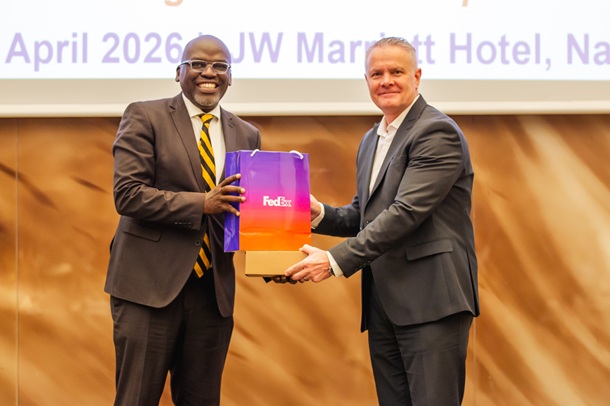
FedEx, in partnership with the Kenya Association of Manufacturers, has called for stronger investment in fast and reliable logistics systems to unlock Kenya’s manufacturing potential and boost export competitiveness.
The call was made during a high-level Industry CEOs Breakfast that brought together senior executives, policymakers, and logistics experts at a time when Kenya is seeking to raise manufacturing’s contribution to GDP from 7.3 percent to 20 percent by 2030, according to data from the Kenya National Bureau of Statistics.
Participants at the forum emphasized that as global supply chains evolve and logistics costs fluctuate, improving the speed, reliability, and integration of transport solutions will be critical for Kenya to remain competitive in international markets.
The discussions focused on how the country can strengthen its position in time-sensitive, high-value sectors such as pharmaceuticals, automotive, electronics, and agribusiness—industries that depend heavily on efficient and predictable logistics.
Speaking at the event, KAM Chief Executive Tobias Alando warned that ongoing geopolitical tensions are already straining manufacturers by increasing trade costs and disrupting established supply routes.
“Global dynamics continue to affect the manufacturing sector in Kenya. Beyond global developments, structural factors within the logistics ecosystem, such as regulatory requirements and infrastructure capacity, play a role in shaping the competitiveness of locally manufactured goods in regional and international markets,” he said.
FedEx’s Managing Director of Sales for Sub-Saharan Africa, Leon Bruwer, reaffirmed the company’s long-term commitment to Kenya, noting that the country’s designation as one of only nine direct-serve markets in Africa reflects its strategic importance.
“Kenya is a strategic player in our growth story in Africa. Our continued investment in capacity to and from Nairobi, combined with our global air network, enables businesses to access international markets with greater speed, reliability and predictability,” Bruwer said.
Kenya has already demonstrated the value of efficient logistics through its strong global position in perishable exports such as tea and flowers. However, stakeholders noted that as the country expands into higher-value manufacturing, precision logistics—supported by integrated global air networks—will be essential to maintain product quality, reduce lead times, and meet international demand.
Despite the advantages of air freight, participants acknowledged that its cost and accessibility remain a barrier for small and medium-sized enterprises (SMEs), underscoring the need for policies and industry solutions that make such services more commercially viable across African trade routes.
FedEx also highlighted ongoing efforts to enhance cross-border trade through digital solutions and streamlined customs processes, aimed at helping Kenyan businesses—particularly SMEs—navigate international logistics more efficiently and scale their operations globally.
The forum concluded with a joint commitment by FedEx and KAM to deepen collaboration in strengthening Kenya’s manufacturing ecosystem, with a focus on improving global connectivity, expanding access to efficient logistics solutions, and enabling local businesses to compete more effectively in international trade.