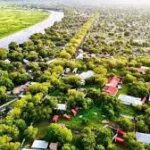
Community leaders, government officials, and development partners have launched a new project to address water scarcity and reduce cattle related conflicts in parts of Terekeka County, Central Equatoria State.The project, funded by the UNMISS through its quick impact projects program and implemented by Salaam Junub will involve the construction of a large water reservoir to serve pastoralist communities in Reggo and Rijong Payams.
The launch ceremony took place in Mirinda bomma, bringing together state government officials, county authorities, traditional leaders and members of the local community.
Speaking during the event, the chief of Mylinda Boma, Lino Kenyi Jokudu, expressed gratitude to the partners and government officials for bringing development to their area.
“We are very happy that you are here. We have never seen the government come here or extend its services to us in Mirindya. Today, we appreciate you for bringing this service,” Lino said.
He said the reservoir would benefit both cattle keepers and local families, providing water not only for livestock but also for domestic use.
“This reservoir will be owned by everyone and it will serve everyone around this area. If it is expanded well, pastoralists will bring their cattle here to drink and feed, and our families will also use the water for daily needs,”he added.
Chief Jokudu urged project partners to ensure the reservoir is large enough to store sufficient water during the dry season.
“We hope it will not be small but big enough so that it keeps enough water for us during the dry season,” he said
The Executive Director of Salaam, Bush Buse, said the project is designed to help address cattle related conflicts that often arise due to water shortages.
“This project is funded by UNMISS through the Quick Impact Projects department. It is an intervention to reduce cattle related conflict in Terekeka County, particularly in the Central Mundari areas of Reggo and Rijong,” Buse explained.
According to Bush, the project involves construction of a water valley tank, commonly known as a hafir, capable of storing 15,000 cubic meters of water.
“The construction is expected to take about three months before it is completed and handed over to the community,” he said.
He added that access to a permanent water source would help reduce seasonal cattle migration, which often leads to clashes with the neighboring communities.
“When cattle remain here instead of migrating south in search of water, it will help bring peace. Families will also benefit because women and children will have access to milk and more time to attend school,” Buse said.
Meanwhile, the state Minister for Peacebuilding, Hon Jacob Aligo, who was the guest of honor of the event said the project was initiated following peace conferences where communities repeatedly raised concerns about water shortages.
“We all know that this area faces serious water challenges. Sometimes this scarcity leads to conflicts among cattle herders and also forces cattle migration to other parts of Central Equatoria State,” he said.
He further added that the site was strategically chosen because it sits between Reggo and Rijong payams, allowing communities from both areas to benefit.
“This location links the two payams, making it a central point where cattle herders and residents can access water,” he said.
The state Minister for agriculture, environment, and forestry Lily Kafuki also highlighted the environmental importance of the project.
She said that climate change continues to affect South Sudan, increasing the need for sustainable water management systems.
“This water catchment will support environmental initiatives such as tree planting and improve agricultural activities in the area,” she said.