
High Prevalence and Clinical Complexity of the Metabolic Triad
The “Three Highs” represent a substantial health burden in Hong Kong. According to 2020–2022 population health survey, 8.5%, 29.5%, and 51.9% of residents aged 15–84 are affected by hyperglycemia, hypertension, and hyperlipidemia respectively. These conditions collectively drive cardiovascular mortality, accounting for one in five deaths in Hong Kong. Stroke alone claimed over 3,000 lives in 2023, ranking as the city’s fourth leading cause of death.
Dr David Lui Tak-wai, Specialist in Endocrinology, Diabetes & Metabolism, Clinical Assistant Professor, Department of Medicine, School of Clinical Medicine, HKUMed, explained the underlying pathology: “The ‘Three Highs’ damage the vascular endothelium through distinct biological pathways, accelerating atherosclerosis, luminal narrowing, and plaque formation. This significantly increases the risk of cardiovascular events such as coronary heart disease, heart failure, and peripheral arterial disease” He further detailed specific stroke risks, “Hyperglycemia increases the risks of ischemic and hemorrhagic stroke by 2.3-fold and 1.6-fold respectively, while hyperlipidemia substantially elevates ischemic stroke risk as well.”
“Mitigating severe event risk requires moving beyond individual biomarker management to embrace holistic vascular protection,” Dr Lui emphasised. “Current assessment relies heavily on physician experience and internationally-derived tools. A precision model built on local data and AI can transform this paradigm, enabling superior risk evaluation, tailored treatment strategies, and more effective patient communication – particularly regarding underappreciated risks such as lipid control.
Biu (pseudonym), a patient living with hypertension and diabetes, was hospitalized earlier this year after experiencing sudden chest tightness. During his stay, medical professionals discovered that two of his coronary arteries were severely blocked, necessitating immediate coronary angioplasty surgery.
This cardiovascular event has significantly altered Biu’s lifestyle. He now relies on long-term medication and has completely transformed his daily habits. Despite these changes, he continues to grapple with anxiety and uncertainty, as his condition places him at a higher risk for further health complications.
Biu believes that a risk prediction tool could serve as a valuable reference point, helping him gain clarity in planning his health goals. Such a tool would not only provide him with reassurance but also offer peace of mind to his family, whom he treasures deeply. ”
P-CARDIAC: Personalised Risk Stratification for Precision Treatment
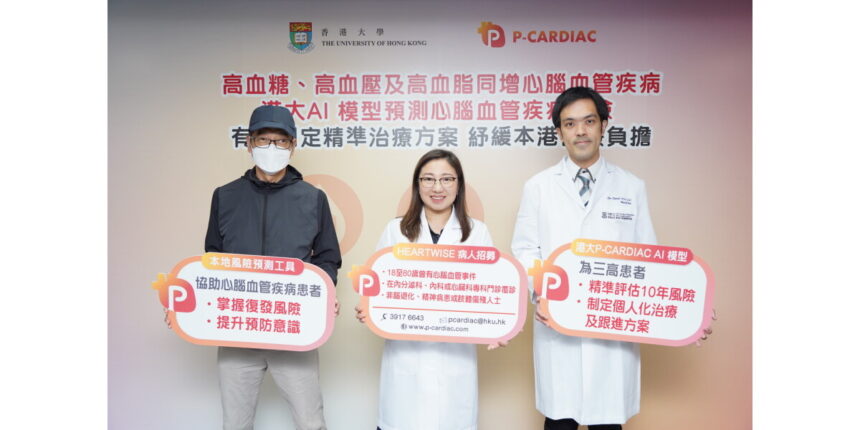
Professor Celine Chui Sze-ling, Assistant Professor, School of Nursing, HKUMed, explained that P-CARDIAC was developed using up to 13 million electronic medical records from the Hospital Authority. By analysing over 120 risk variables while incorporating individual patient characteristics, the model generates personalised risk scores specifically validated for Chinese populations. To establish clinical utility, the HKU School of Nursing launched the HEARTWISE study in 2024. In collaboration with cardiologists, endocrinologists, pharmacists, and nurses, the study enrolled patients with previous cardiovascular events from public hospitals.
HEARTWISE Interim Findings: Personalised Risk Patterns Emerge
1) Over 90% of cardiovascular patients presented with at least one “Three Highs” condition
By August 2025, the study had recruited 1,248 patients, with 94% exhibiting at least one metabolic disorder. Among these, approximately one-fourth presented with all three conditions while 42% had two concurrent disorders.
2) Ten-Year Recurrence Risk Reaches 70%, with Significant Variation Across Risk Profiles
P-CARDIAC analysis revealed a 70% overall ten-year recurrence risk among patients with “Three Highs” components. This risk escalated to 72% for patients with all three disorders. Notably, patients with only hypertension and hyperlipidemia demonstrated an equally elevated 73% risk, underscoring the need for individualised management strategies based on specific risk combinations.
3) Stroke Survivors Face Particularly High Recurrence Rates
Analysis of the 10% of participants who were stroke survivors showed a 74% risk of subsequent cardiovascular events within ten years, indicating a critical need for intensified monitoring and secondary prevention.
Professor Chui emphasised the clinical implications, “These findings demonstrate AI’s transformative potential in clinical decision-making. We recommend healthcare professionals from both public and private healthcare systems integrate P-CARDIAC into their practice for predicting major cardiovascular event risks and developing personalised treatment plans. We anticipate P-CARDIAC will enable multidisciplinary teams to optimise prevention strategies, improve resource allocation, and ultimately reduce the healthcare system’s long-term burden.”
The HEARTWISE study continues recruitment across six public hospitals: Queen Mary Hospital, Queen Elizabeth Hospital,
Kwong Wah Hospital, Princess Margaret Hospital, Tuen Mun Hospital, and Pok Oi Hospital. The research aims to further validate P-CARDIAC’s effectiveness in improving patient outcomes and expanding its precision treatment applications. Patients receiving cardiovascular care in cardiology, internal medicine, or endocrinology departments at these institutions may participate. Interested individuals can contact the HKU School of Nursing research team at 3917 6643 or pcardiac@hku.hk.
Hashtag: #ThreeHighs #CardiovascularDisease #ArtificialIntelligence #HKU #UniversityOfHongKong #RiskPrediction #ProfCelineChui #DrDavidLui #P-CARDIAC #Stroke #HeartDisease
The issuer is solely responsible for the content of this announcement.
About P-CARDIAC and HEARTWISE Study
The P-CARDIAC initiative represents a significant advancement in cardiovascular risk assessment tailored specifically for the Hong Kong population. Developed through a collaborative effort between academic institutions and healthcare partners, P-CARDIAC utilises machine learning to provide personalised 10-year cardiovascular risk predictions for individuals with established acute coronary syndrome. The HEARTWISE study aims to validate the clinical utility of P-CARDIAC in real-world settings, ensuring that healthcare providers can effectively utilise this tool to enhance patient outcomes. By integrating pharmacist-led services into the management of cardiovascular conditions, HEARTWISE seeks to alleviate the burden on healthcare systems while improving the quality of care for patients.
The P-CARDIAC model represents a significant collaboration among key stakeholders aimed at improving cardiovascular risk assessment in Hong Kong. This initiative is led by principal investigator, Professor Celine Chui Sze-ling, Assistant Professor, School of Nursing, HKUMed, and co-principal investigator, Professor Ruibang Luo, Associate Professor of the Department of Computer Science, Faculty of Engineering, The University of Hong Kong.
The development of P-CARDIAC was supported by the Innovation and Technology Fund of the Innovation, Technology and Industry Bureau, with matching fund from Amgen Hong Kong, an international biopharmaceutical company focusing on developing pipeline medicines to address unmet medical needs while leveraging state-of-the-art science to drive solutions that improve health outcomes.
With the use of P-CARDIAC, the HEARTWISE study benefits from the active involvement of six hospitals under the Hong Kong Hospital Authority, which facilitates real-world implementation, data collection and comprehensive data analysis. Together, this study symbolises a multidisciplinary collaboration to commit advancing innovative and evidence-based strategies to address the rising burden of cardiovascular diseases.